
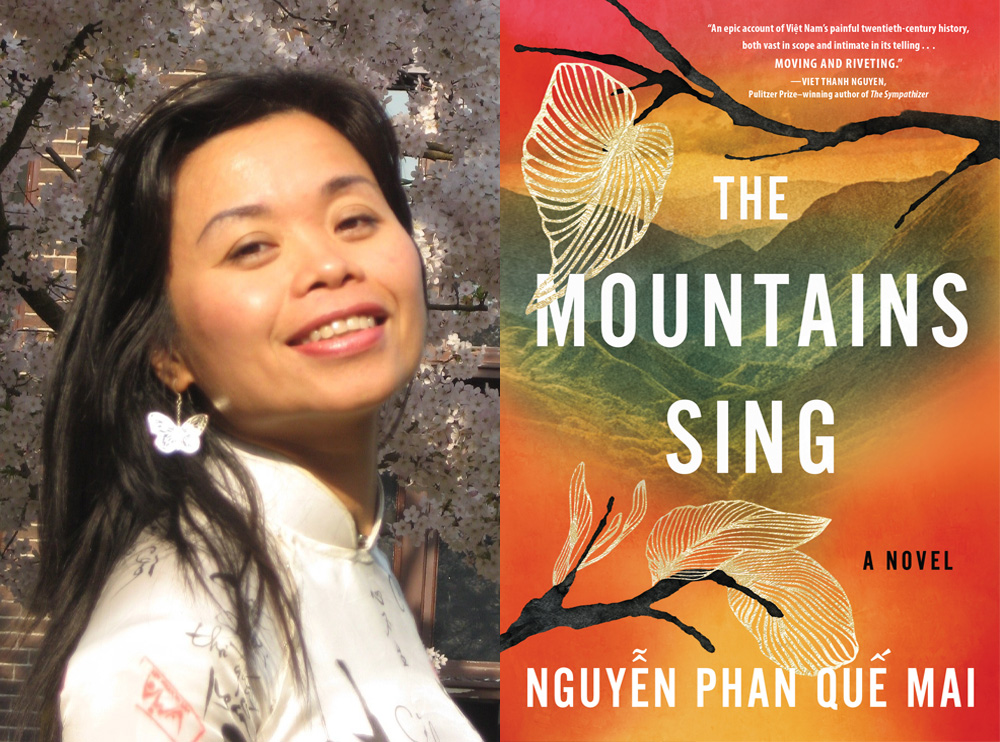
ThE MOUNTAINS SING
A Journey Through Vietnam’s Past
The Rare Review
For most of my life, I have been drawn towards romantic novels, suspense thrillers, and occasionally a few self-help books. Historical fiction was never really my preferred genre.
That changed when I started travelling to Vietnam frequently.
The more time I spent in the country, the more curious I became about its history. Vietnam’s story is unlike any other — decades of colonial rule, wars against the French, Japanese occupation during World War II, conflict with China, and eventually the Vietnam War that shaped the modern nation we see today.
Wanting to understand Vietnam beyond its food, cities, and landscapes, I searched for books that could help me connect with the country’s past. That search eventually led me to The Mountains Sing by Nguyễn Phan Quế Mai.
What I expected to be a history lesson turned out to be one of the most immersive reading experiences I have had in years.
The novel follows four generations of the Tran family, spanning from the French colonial era to the reunification of Vietnam in 1975. At the heart of the story are two unforgettable characters — Diệu Lan, the grandmother, and Hương, her granddaughter.
What impressed me most was the author’s ability to move effortlessly between generations while keeping the emotional core of the story intact. The book never feels like a history textbook. Instead, it feels deeply personal.
Reading it often felt less like reading a novel and more like watching a film inside my own imagination.
Through Diệu Lan’s experiences, we witness the collapse of privilege, the devastation of famine, land reform, family separation, and survival against impossible odds. Through Hương’s eyes, we experience the uncertainty, fear, and sacrifices of a country at war.
One of the strengths of the novel is how it constantly shifts between the past and the present. Few authors can make readers empathize so deeply with multiple generations while also portraying the complexities of history without turning characters into heroes or villains.
The book’s timeline covers some of the most important periods in modern Vietnamese history:
- French colonial rule and Japanese occupation.
- The Great Famine of 1944–45.
- Communist land reform in the 1950s.
- The Vietnam War and the eventual reunification of the country in 1975.
Among the many moments in the novel, one revelation near the end stayed with me. Early in the story, a seemingly minor character known as the “Wicked Ghost” appears to be little more than a cruel supervisor taking advantage of difficult circumstances. Later, when his connection to Tam’s family is revealed, the significance of that earlier storyline suddenly becomes clear. It was one of the most satisfying twists in the entire book and a reminder that seemingly small details can have lasting consequences.
The novel is also surprisingly easy to read despite covering such heavy themes. The pacing, especially through the first three quarters of the book, kept me turning pages long after I had planned to stop reading.
However, I did feel the final section was weaker than the rest.
After spending so much time carefully developing the characters, the last few chapters felt rushed. Several important storylines deserved more space and closure. Personally, I would have liked to know more about Minh’s later life, understand the family’s future in greater depth, and spend more time with Hương and Tam after their marriage.
The ending is certainly emotional, but I felt another chapter or two would have made the conclusion even more satisfying.
That said, this does little to diminish what the book achieves overall.
The Mountains Sing helped me understand Vietnam in a way that museums, documentaries, and history articles never could. It transformed historical events into human experiences and reminded me that behind every war, revolution, and political movement are ordinary families trying to survive.
If you have visited Vietnam, plan to visit Vietnam, or simply enjoy historical fiction that combines family drama with real-world events, this book deserves a place on your reading list.
Should You Read It?
⭐⭐⭐⭐⭐ 4.5/5 – Yes, Absolutely.
If you enjoy historical fiction, family sagas, and books that help you understand a country’s history through ordinary people, The Mountains Sing is absolutely worth reading.
Written & Edited By Amit Shriwas • Published on 10 May 2026 • Rare Reviews • Book • 4 min read
📖 Buy The Mountains Sing on Amazon
Disclosure: As an Amazon Associate, I earn from qualifying purchases. This comes at no additional cost to you and helps support Amit On The Move.