
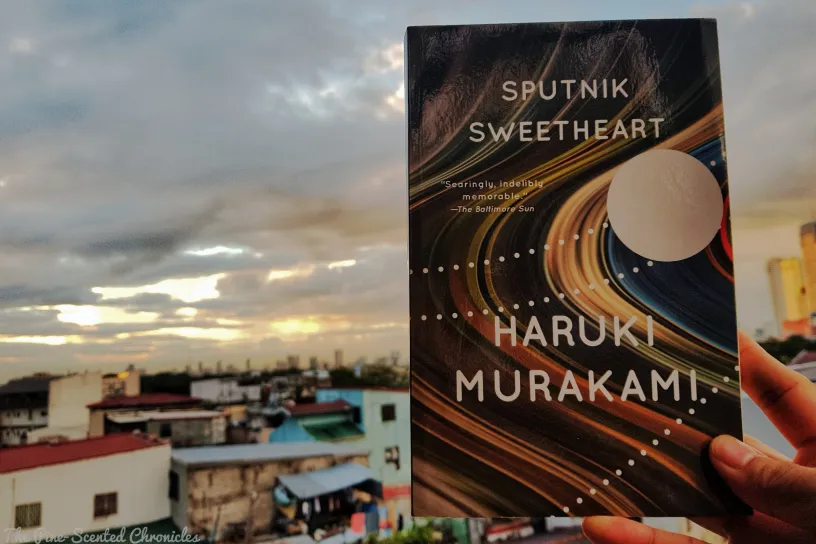
SPUTNIK SWEETHEART
A Journey Through Love, Loneliness and Parallel Worlds
The Rare Review
My journey into Haruki Murakami’s world began with a short synopsis of Norwegian Wood. Curious about the author, I picked up the book and was instantly fascinated by his ability to blend ordinary lives with extraordinary emotions. A review of Norwegian Wood will follow soon, but today I want to talk about another Murakami novel that stayed with me long after I turned the final page: Sputnik Sweetheart.
At first glance, Sputnik Sweetheart appears to be a simple story about unrequited love. A young man is in love with a woman, that woman falls in love with another woman, and the object of her affection remains emotionally distant. Nothing extraordinary.
Yet, as with many Murakami novels, what begins as a straightforward story slowly transforms into something much deeper.
The title itself refers to the Soviet satellite Sputnik. Murakami uses it as a metaphor for human relationships. Like satellites orbiting through space, people occasionally cross paths, influence one another, and travel together for a brief period. Yet despite their closeness, they often remain isolated, unable to truly reach one another.
While some readers may initially view the novel primarily through its LGBTQ themes, the story is ultimately about loneliness, longing, identity, and the invisible distances that separate people from one another.
When Love Is Not Enough
The novel revolves around three central characters:
Sumire – A passionate, chaotic, and aspiring writer who lives intensely and often impulsively. Her life changes when she meets Miu at a wedding.
K – The narrator of the story, an elementary school teacher who quietly carries a deep and unrequited love for Sumire.
Miu – An elegant and sophisticated businesswoman, seventeen years older than Sumire, whose mysterious past shapes much of the novel’s emotional landscape.
The emotional triangle is deceptively simple:
K loves Sumire.
Sumire loves Miu.
Miu is unable to fully return that love.
But Murakami is not interested in creating a conventional love story. Instead, he explores what happens when people desperately want connection but find themselves unable to bridge the emotional distance between them.
The Mystery Beneath the Surface
As the story progresses, Sumire accepts a job working for Miu, and the two travel through Europe before arriving on a quiet Greek island.
There, under the weight of her emotions, her inability to write, and her longing for Miu, Sumire begins to unravel.
Then she disappears.
Without warning.
Without explanation.
Miu contacts K, who immediately flies to Greece in search of the woman he loves.
From this point onward, the novel slowly shifts from a story about relationships into a mystery that blurs the boundaries between reality, memory, dreams, and parallel worlds.
Murakami introduces a mysterious event from Miu’s past that challenges the reader’s understanding of what is real and what exists only in the subconscious. Whether the event literally occurred or serves as a metaphor is left intentionally unresolved.
And that uncertainty is precisely where Murakami thrives.
Why Sputnik Sweetheart Stayed with Me
Long after finishing the novel, I found myself thinking about the characters.
Not because the mystery was solved.
In many ways, it wasn’t.
Murakami rarely provides neat conclusions. Instead, he leaves readers standing at the edge of unanswered questions and invites them to live with the uncertainty.
For me, Sputnik Sweetheart is ultimately a novel about loneliness.
Not the loneliness of being physically alone.
But the loneliness of never being completely understood by another person.
The characters spend the entire novel reaching for connection, yet something always remains just beyond their grasp.
Like satellites orbiting through the same sky, they come close enough to see one another, influence one another, and even change one another. Yet they never fully collide.
That lingering feeling stayed with me long after I finished the final page.
And perhaps that is Murakami’s greatest gift as a writer. He does not simply tell a story. He leaves behind a question, a feeling, and a quiet sense of wonder that follows you for weeks, months, and sometimes years afterward.
Should You Read It?
⭐⭐⭐⭐⭐ 4.5/5 – Yes, Absolutely.
If you enjoy literary fiction, psychological mysteries, and stories that blur the line between reality and imagination, Sputnik Sweetheart is a journey worth taking.
Written & Edited By Amit Shriwas • Published on 14 June 2026 • Rare Reviews • Book • 4 min read
📖 Buy Sputnik Sweetheart on Amazon
Disclosure: As an Amazon Associate, I earn from qualifying purchases. This comes at no additional cost to you and helps support Amit On The Move.